Chelsea Tank Farm Gasoline Release — FAQs

Location of the Spill

The release occurred on the northwestern corner of MIPC’s approximately 160-acre Chelsea Tank Farm, located at 920 Cherry Tree Road, Aston, PA. The specific area of focus is primarily to the west, south, and southwest of Tank 708.
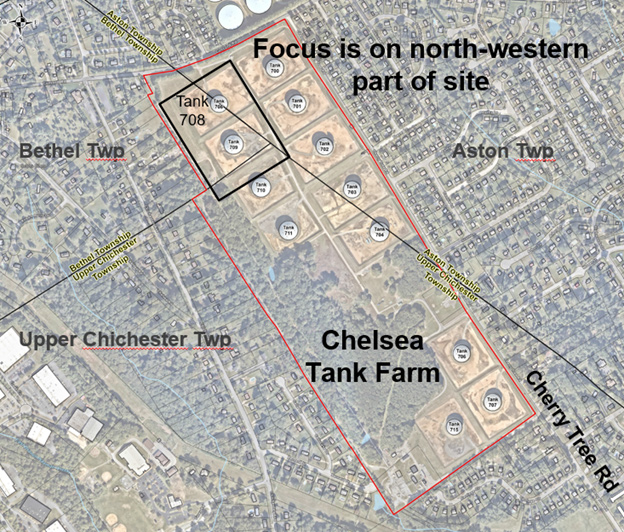
The product is gasoline.
The cause of the leak was determined on December 13th to be a pencil eraser-sized hole in the floor of Tank 708.
For some background, the federal agency tasked with regulating the transportation of our products is the Pipeline Hazardous Materials Safety Administration (PHMSA). As required by PHMSA regulations, MIPC had to submit a “worst case estimate” as soon as possible after discovering and confirming the source. So once MIPC determined the source, this then initiated that process by which MIPC could calculate the maximum potential release total based on data and evidence. This is how and when MIPC arrived at the potential total release of 9,000 barrels of gasoline. This amount may be revised as the investigation continues.
Tank 708 was last inspected pursuant to industry standards and certified to return to operational service in March 2025. The inspection was conducted by a certified third-party inspector. It was noted at the time by the inspector that Tank 708 was in excellent condition and no issues were identified.
No, Tank 708 was taken out of service and de-inventoried beginning on November 21, 2025. This tank will remain out of service until PHMSA approves its return to service.
No, that’s still being investigated. MIPC has installed dozens of monitoring wells along the internal property boundary in order to accomplish this goal and is conducting additional assessments offsite to understand conditions. Delineation efforts of gasoline product to the north, south, east, and southwest are complete and limited to on-site impact. MIPC is also requesting access offsite in a handful of cases to conduct our investigation in support of delineation to the west.

Release Investigation and Response Actions

Yes, MIPC is working with Langan, a specialized engineering and environmental firm widely known for its expertise in ground contamination, investigations, and recovery.
Yes, investigation activities are still required. In accordance with the December 23, 2025 Order issued by PADEP, ongoing interim remedial action responses, investigation activities, and remedial actions are required until such time that the gasoline release has been characterized, delineated, and cleaned up to the standards set by PADEP. All investigation and remediation activities are subject to the Department’s approval under the Pennsylvania Land Recycling Program (referred to as Act 2). The timeline for completing the cleanup activities is dependent on several factors including:
  • Data and information collected as part of the ongoing investigation,
  • Design, implementation, and monitoring of remedial system(s), and
  • Final demonstration of attainment of the Pennsylvania Act 2 remediation standards as approved by the Department.
Response actions are driven by the results of investigations. MIPC’s priority is completing the investigatory work thoroughly, responsibly, and in compliance with the PHMSA and PADEP Orders.
MIPC encourages everyone that is interested in receiving updates to send an email to [email protected] or sign up for email updates on the “Contact Us” page of this website.
The recovery of gasoline product from the subsurface was initiated in September 2025 with the installation and continued operation of a water treatment unit. Those efforts were enhanced in early December, and we have been actively performing Vacuum Enhanced Fluid Recovery (VEFR) in multiple monitoring wells where product is encountered. Since January 23rd, we have conducted multi-well extraction using a manifold system to safely and efficiently remove product. Additionally, we have also conducted hand-bailing in various locations. MIPC is undertaking all of this work with a sense of urgency and focus on safety for those on and offsite. MIPC is committed to continuing our response and recovery actions.
MIPC is actively evaluating noise mitigation options, including the use of quieter equipment where practicable, sound barriers where feasible, acoustic enclosures, work sequences to reduce peak noise periods, and directing work to occur between the hours of 8:00AM and 5:00PM, all in an effort to minimize noise impacts that could be heard offsite.
***This is an evolving area, and as noise reduction measures are implemented, this response will be updated to reflect new efforts.

Public Information

In the course of the investigation, MIPC discovered a ¼-inch hole (roughly the size of a pencil eraser) in the steel floor of Tank 708 on December 13, 2025. This finding led MIPC to estimate the potential amount of product released, which was provided to PHMSA in a supplemental report to PHMSA on December 16, 2025. PHMSA accident investigators arrived on-site on December 18, 2025. MIPC notified neighbors of the investigation findings via door-to-door conversations on December 31, 2025. See the ‘12.31.25 Community Update Letter’ in the “PADEP Order & Communications” section of this website.

Bottled Water

At this time, none of the over 40 residential wells that have been sampled indicate that they have been impacted by this release. None of the sample results exceed even the most stringent safe drinking water standards. In two instances to date, wells tested have detectable levels of gasoline-related compounds. These detections are below the state (PADEP) and federal (EPA) drinking water standards.

  • At one property, concentrations of only a few gasoline-related compounds were detected in water samples collected from a private well on January 14 and 28, 2026. The detections are mostly estimated concentrations because they are below the lab reporting limit that can be confidently reported by the lab. Furthermore, all reported concentrations are at least an order of magnitude (i.e., 10 times or more) below the PADEP and EPA standards, as shown in the table below. Additionally, this well is located over 700 feet west-southwest of the site, and the results are inconsistent with other private water well and monitoring well results. Water sampling results from over 40 other private water wells, many of which are located nearer to the release than this well, indicate non-detectable levels of the same compounds detected in this well. As a precaution, routine monitoring is planned for this private well, and the property owner is being provided with bottled water.
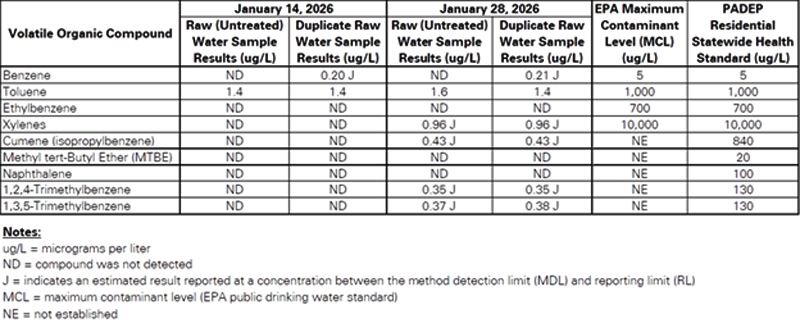
  • At another property, a low concentration of one gasoline-related compound (p/m-xylene) was detected during only the second round of sampling from a private well on January 29, 2026. This same compound was not detected in the duplicate sample (an additional sample taken at the same time). PADEP also collected a sample before the Langan samples were taken on this same date with the sample results being non-detect.
  • Additionally, this compound was not detected in the first sample collected from this private well on January 7, 2026. The lone detection of total xylenes (0.56 micrograms per liter or ug/l) is not only inconsistent with these other sample results but is orders of magnitude below the PADEP and EPA drinking water standards, both of which are 10,000 ug/L.

As a precaution, routine monitoring is planned for this private well, and the property owner is being provided with bottled water.

Samples are sent to a PADEP-accredited, third-party lab to test the samples using an EPA-defined method. These samples are collected through our contracted engineering company. If residents wish to conduct their own testing, MIPC has and will also cover the costs associated with that testing.

If sampling shows that petroleum-related compounds have impacted a neighbor’s well water above Act 2 statewide health standards, per PADEP’s Order, MIPC will offer to install a point-of-entry water treatment system (“POET”) to ensure safe household water. Although not required by PADEP, MIPC will also offer to provide connection to public water as a second option if a resident would prefer. In both cases, the installation of these would come at no cost to the property owner.

In the case of a POET system, MIPC will increase the frequency of water testing at their home and closely monitor system performance.

Because MIPC believes it’s the responsible thing to do. In fact, it was an integral aspect of MIPC’s plans even before it became part of the PADEP-required remedial response. It provides residents peace of mind while MIPC continues gathering data and ensures that MIPC is ready to act quickly if conditions change.
Properties with a potable groundwater well located within 1,000 ft. of MIPC’s western property line may receive bottled water. MIPC is and will continue to supply bottled water to properties within this boundary that make the request. Bottled water will be provided until PADEP orders MIPC to discontinue providing bottled water service.
To receive bottled water, property owners or tenants with potable wells within the western boundary can contact MIPC at 610-364-8426 or [email protected]. MIPC will request to know how many individuals and pets reside at the property. Thereafter, MIPC will provide bottled water through a recurring water service, beginning within 24 hours of a request.
No, residents do not need to sign anything to receive bottled water. Residents with groundwater wells who reside within the 1,000-foot western property line only need to contact MIPC at 610-364-8426 or [email protected] to request bottled water.

Monitoring Wells/Residential Wells

No, residents do not need to sign anything to have their well tested. Langan (MIPC’s contracted engineering firm) requests that property owners complete a well questionnaire to the best of their ability. The purpose of the well questionnaire is to aid Lagan in better understanding the location of the well, depth, age, and other important factors before collecting samples.

EPA and PADEP are the federal and state entities charged with protecting health & the environment. These agencies set the standards for safe drinking water and these standards are used in evaluating the drinking water sample results for the tested gasoline-related compounds compared to their safe drinking water standards.

Private well sampling results are compared to U.S. EPA Safe Drinking Water Act (SDWA) Maximum Contaminant Levels (MCLs) for regulated gasoline-related compounds, where such values have been established. MCLs are enforceable standards for public water systems. For private drinking water supplies, PADEP routinely applies these criteria as conservative benchmarks.

Applicable MCLs include, but are not limited to:

  • Benzene: 5 microgram per liter (µg/L)
  • Toluene: 1,000 µg/L
  • Ethylbenzene: 700 µg/L
  • Total xylenes: 10,000 µg/L

These values represent concentrations protective of human health for lifetime consumption and serve as the primary drinking water criteria for constituents with established MCLs.

For petroleum-related constituents that do not have federal MCLs (e.g., MTBE, naphthalene, isopropylbenzene, trimethylbenzenes), analytical results are compared to Pennsylvania Act 2 Residential Statewide Health Standards for groundwater used as drinking water (Medium-Specific Concentrations, MSCs). Act 2 MSCs are risk-based criteria developed to protect residential potable groundwater use and are appropriate for evaluating private drinking water well data.

Where both an EPA MCL and an Act 2 MSC are available for a given compound, the more stringent value will be used as the screening benchmark.

Applicable Act 2 MSCs include, but are not limited to:

  • Isopropylbenzene (Cumene): 840 µg/L
  • MTBE: 20 µg/L
  • Naphthalene: 100 µg/L
  • 1,2,4-Trimethylbenzene: 130 µg/L
  • 1,3,5-Trimethylbenzene: 130 µg/L
Residents closest to the northern and western boundaries of our property, where our activity is taking place, have not reported any sediment concerns in their wells.

First and foremost, MIPC provides the results of private well sampling to each respective property owner(s). MIPC then shares these results with PADEP in each weekly report. Private well results are typically treated as the homeowners’ personal information and may include personal identifiers or property-specific details. To protect the privacy of our neighbors, MIPC does not publish the sampling results of individual properties.

The weekly report that MIPC provides on this website does include the aggregate findings of private well sampling.

Yes, MIPC has developed a continuing groundwater supply well monitoring program to confirm safe drinking water and, over time, to assess potential changes in water quality. Monitoring frequencies are based on the proximity of the groundwater supply well to the western boundary of the impact area and the baseline sampling results. The private drinking water well sampling plan is available on this website under the Remedial Action Plans and Other Technical Documents page.

Monitoring frequency and well selection may be adjusted over time based on cumulative results. Any modifications to the monitoring program would be submitted to PADEP for review and concurrence.

Air Monitoring

MIPC’s air monitoring data, which is shared with PADEP each week, has not indicated sustained detections of gasoline-related volatile organic compounds above screening levels in the ambient air at our facility fenceline. Air monitoring is performed 24 hours a day to document air conditions and relevant changes. This process takes into account a number of factors such as activities in the vicinity of the monitoring stations, weather data, and more. If a neighbor notices an odor, we encourage them to contact MIPC at 610-364-8426, and MIPC will send out a team to investigate and take action if warranted.
MIPC began continuous 24-hour fenceline perimeter air monitoring on December 30, 2025. In the initial days of air sampling, it was necessary for an individual to physically collect the samples at midnight on each sampling day. By the second week of air monitoring, MIPC had procured timers to allow for a more efficient and quieter method of sample collection. MIPC continues to listen to our neighbors and works with PADEP to ensure that MIPC both meets our obligations while also taking our neighbors’ concerns into consideration.
Yes, air monitoring results are shared with PADEP each week and are available for public review under the “Remedial Action Plans and Other Technical Documents” tab on this website.

PHMSA Investigation

As required, Tank 708 was subject to an industry inspection in the Spring of 2025, which demonstrated the integrity of the tank was in excellent condition. During the initial investigation period, multiple onsite tests and leak detection efforts were conducted to evaluate Tanks 708 and 709 to identify a potential release. These efforts included static hold and pressure tests, pothole digs and excavations, gas testing performed on underground test stations, and more. MIPC also uses a FLIR camera, which is a specialized infrared camera that allows the user to see volatile organic compound vapors through the lens. None of these tests demonstrated that there was a release occurring from Tank 708.

In practical terms, every time product is transferred into or out of a tank, there are small measurement variances due to:

  • Gauge precision limitations
  • Temperature fluctuations affecting volume readings
    • A single degree temperature drop (from 80°F to 79°F) causes the tank level to change by approximately 3/16 of an inch.
    • The leak was causing a level drop of only 1/100th of an inch per hour.

This means the temperature effect from a one-degree change is roughly 18 times greater than the hourly loss from the leak. Normal daily temperature swings would create level changes that completely masked the existence of a leak.

Release detection is evaluated using multiple lines of evidence, and investigations may take time to confirm a source, timing, and pathway – especially where subsurface conditions are complex. So, while the loss is detectable in hindsight now that we know a hole existed, there were so many of these variables that it was not apparent at the time. The data was further complicated because other evidence (proximity and sampling) initially pointed toward a different tank as the potential source.

MIPC’s core value of superior environmental performance has led us to use professional engineering and rigorous inspection techniques to detect tank leaks. For 13 years these performance standards have provided safeguards against unknown releases. Because this release was caused by a man-made hole, MIPC has developed new procedures to protect against any future releases. Furthermore, MIPC will implement the recommendations of our 3rd party PHMSA investigator and PHMSA themselves.

Government Oversight

PHMSA is a federal agency focused on certain safety and integrity aspects under its jurisdiction. PADEP is the primary Pennsylvania agency overseeing environmental investigation and remediation, including requirements for site characterization, monitoring, and cleanup standards (including Act-2).

The primary differences between a PHMSA Corrective Action Order (CAO) and a PADEP Act-2 order lay in their scope, focus, and jurisdiction. PHMSA CAOs are federal enforcement actions focused on immediate, urgent safety risks for operating pipelines & storage tanks, while PADEP Act-2 is a Pennsylvania state program primarily focused on environmental remediation, cleaning up contaminated soil and groundwater to agency-set standards.

No, this release will not cause the site to be designated an EPA superfund site.

Other Environmental Events

No.

In August 2025, a significant fish kill occurred in the West Branch of Chester Creek in Aston Township. As confirmed by Delaware County Emergency Services, this event was traced to a Chester Water Authority (CWA) pump station. Hazmat crews and officials identified the pollutant as a likely chlorine-based substance, not petroleum, affecting the creek near Mount Road.

Source: https://www.cbsnews.com/philadelphia/news/dead-fish-aston-pennsylvania-chester-creek/

MIPC personnel have continued conducting routine weekly inspections of multiple outfalls, the tributary of Marcus Hook Creek known as Bezer’s Run, and Marcus Hook Creek. No indications of impacts to surface water (e.g., sheen, odors, pooled product, stressed vegetation) have been identified to date.

No.

The P66 release occurred along Cherry Tree Road in December 2009. This event is unrelated to the current investigation and happened prior to MIPC’s ownership of the Chelsea Tank Farm. There is no known comingling between the P66 release and the current release. P66 is responsible for all remedial actions stemming from the 2009 release. Specific questions on the 2009 release are best directed to PADEP.

Property Values

If damage is caused by the tank release, then yes. MIPC’s commitment is to take responsible action based on confirmed damages. That includes providing monitoring, mitigation, and restoration, as may be required, at no cost to our neighbors.
When a property owner lists and sells their home, MIPC will discuss any concerns regarding a decrease in value that may be attributable to the release. MIPC will address each property sale on a case-by-case basis.

Vapor Intrusion

The potential for vapor intrusion is evaluated using Pennsylvania’s established guidance and screening approaches. This typically involves reviewing subsurface data (soil/groundwater), drilling, soil gas testing, hydrology testing, and modelling, which are all being done to ensure that MIPC identifies potential vapor intrusion risks. In a few instances, MIPC has requested access to neighboring properties, in part specifically in an effort to assess the risk of vapor intrusion. This is one of the steps MIPC is taking to keep our neighbors safe and protect the environment.
MIPC cares deeply about this community, and we take our responsibility to our neighbors seriously. Should you have any questions that are not addressed within this FAQ, please contact us at 610-364-8426 or [email protected].
Scroll to Top